Collaborators : Hi Constructions (Aust) Pty Ltd (Builder), Laura Grey (Heritage Architect) Shire of Merredin, Public Transport Authority
Awards : Outstanding Nominee – Engineers Australia Project of the Year Awards 2026
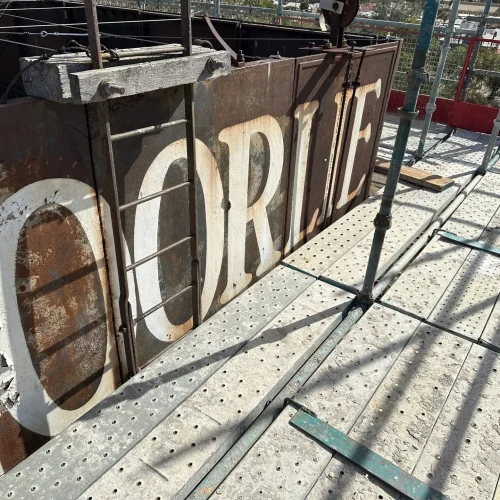
The cast-iron and timber Merredin Water Tank is a scenic turn of the century feat of engineering, dating from the famous CY O’Connor’s 1911 expansion out to Kalgoorlie’s goldfields. The prominent water tower was used to refill steam engines, and was visible from the rail line and highway, lending the town its unique identity.
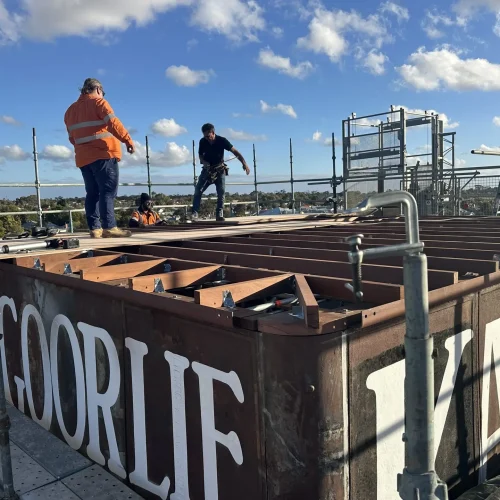
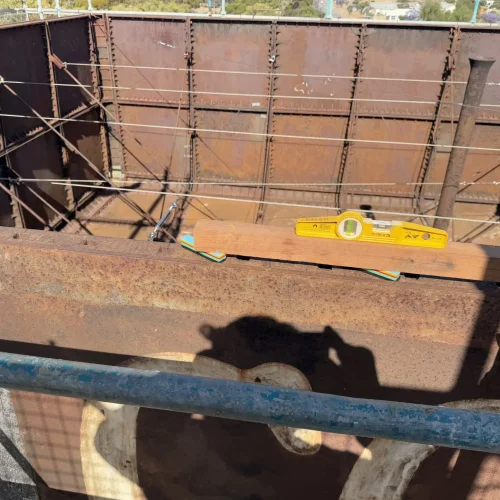
Builder Hi Constructions (Aust) won a tender from Shire of Merredin to demolish or preserve the derelict tank. A previous Structural Engineering report from a different company pushed for demolition and there was a built scaffold in place for inspection. Hi Constructions (Aust) chose to obtain a further Structural Engineering report from Airey Taylor Consulting to check if preservation was possible. ATC’s report confirmed the structure was feasible to remediate using a range of innovative measures.
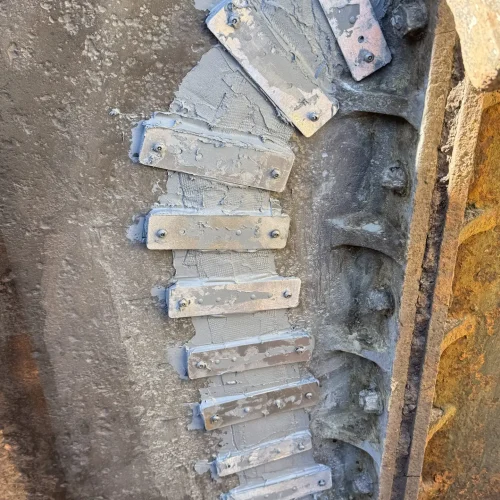
ATC’s Engineering response used a commercially available product (Belzona epoxy/metal fillers) for the first time in a Heritage restoration, excellent structural design for internal bracing and precision remediation work. Patching the many holes of the structure used existing cast iron panels wherever possible, with suitable compatible materials to mimic similar properties of the existing iron. Existing holes in the flange of each panel were used with precision exactitude for fixing points as drilling of the cast hole would crack them.
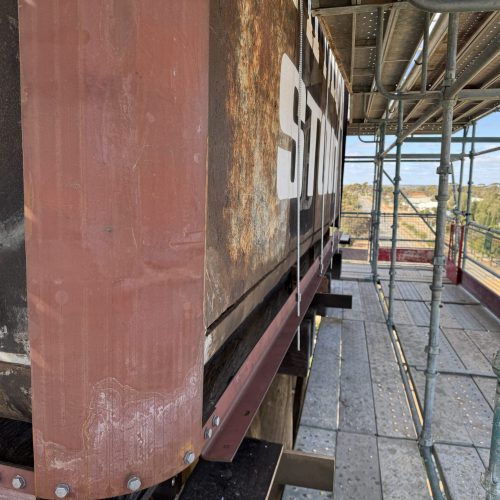
Counterintuitively, patching preceded bracing for long-term stability of the tank. As a protective measure it was mooted to wrap the tank in “shrink wrap” packaging which has suitable breaking strain to hold fragments. The existing scaffolding was finally used as a back-up brace instead. One section fell internally during repairs and had to be lifted and restored from inside of the tank.
When all existing internal debris was removed from the floor, the comprehensive location of damage was understood with photos and documentation mapping cracks and breaks. Internal debris was recycled as repair material wherever possible.
The Belzona product used for patching is normally used for remediation of engine blocks and water pumps – their technical support helped guide its pioneering use for a cast-iron Heritage structure.
Exterior temporary formwork was placed to enable Belzona application to manufacturer specifications. Cast-iron panel remnants and stainless-steel mesh were used for large holes. Careful selection of replacement steel sections/plates for “ageing in place” matches was required as not all panels dated from 1911. A uniform external appearance was achieved including completed stitching.
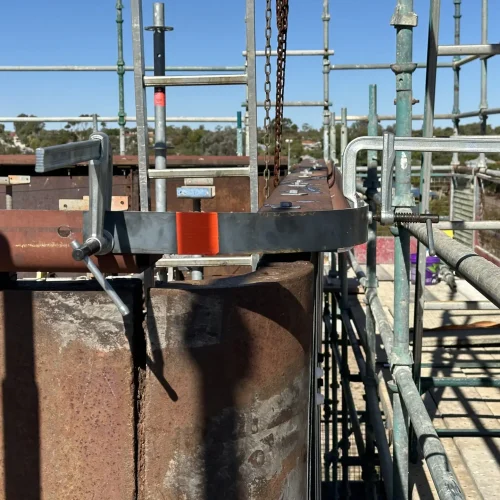
The original design was referenced for bracing/structural integrity fortification, achieved by a tensioning ring top and bottom. The ring and bracing rods remained in place following installation and were not perceptible externally. The design solution created curves in the corners with thin rods in line with the panel joints of the tank, lid and base. Numerous life-sized templates were auditioned for critical elements using full size timber templates and metal curved plate templates for the corners.
Recycling of the original debris/cast iron pieces within the tank were used in preference to any externally sourced material. This adaptive re-use of materials represents an optimum achievement for any modern Heritage project. Sourcing of the timber sections experiencing decay and damage from previous repairs met similar commitment. Second hand jarrah for the timber roof structure was machined to size with recycled railway sleepers used for bottom timber support structure. Supply chains were intentionally minimised with these timbers locally supplied from Northam.
Existing guy-wires holding panels in position were relocated to suit tank stability, as well as the existing panel supports in third quarters of the case that were in good condition. It is an elegant benchmark of new and old materials and methods in Heritage remediation.
With the help of Heritage Architect Laura Gray and Airey Taylor Consulting, the Hi Constructions (Aust) team were able to restore the Heritage “heart” of Merredin, “turning back the clock” to restore the landmark where others thought it impossible. The tank now proudly stands as an accessible tourist site and a testament to superb engineering of the past and present. The project is an official Nominee for the Engineers Australia Excellence Awards Project of the Year Awards.